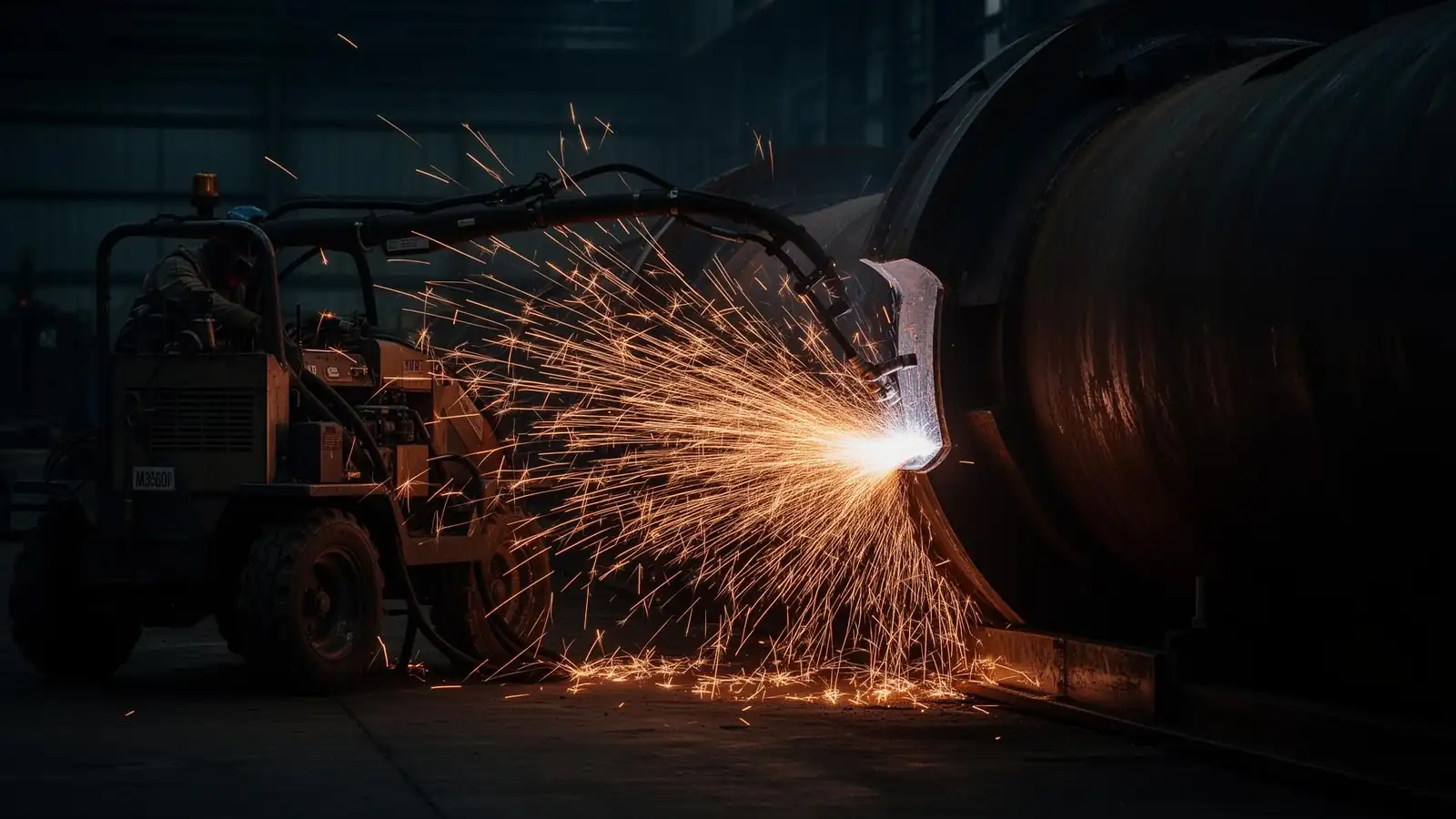
Structural welding on excavators, loaders, dozers, and construction equipment done on your job site. No flatbed, no shop delays. Our mobile rig handles the toughest heavy equipment welding jobs in Yavapai County.
On-site heavy equipment welding in Prescott, AZ. Structural welding for excavators, loaders, and dozers. ROC #361358. Call 928-515-2911. Serving Prescott, Prescott Valley, Chino Valley, Dewey-Humboldt, and all of Yavapai County. ROC #361358. Call 928-515-2911 for a free quote.
Professional Mobile Welding: Heavy Equipment Welding vs. Light Repair
Heavy equipment welding is not the same as fixing a gate hinge. The base metals are thicker, the stress loads are higher, and the consequences of a failed weld can be catastrophic. Our heavy equipment welding work follows proper procedures: full crack removal and V-groove preparation, correct preheat temperatures (200-400F depending on material thickness and carbon content), low-hydrogen E7018 electrodes for Stick welding, and controlled cooling to prevent hydrogen cracking in the heat-affected zone. This is the difference between a weld that holds for a week and one that outlasts the original factory joint.
Professional Mobile Welding: Equipment We Weld On-Site
- Caterpillar, John Deere, Kubota, Komatsu, Case, and Bobcat excavators
- Wheel loaders and skid steers
- Bulldozers and motor graders
- Backhoes and trenchers
- Forklifts and telehandlers
- Dump trucks and haul trucks
- Concrete mixers and pumps
- Agricultural tractors and implements
- Mining and quarry equipment If your steel equipment is cracked or broken, we can weld it on your job site.
Professional Mobile Welding: Common Heavy Equipment Welding Repairs
Bucket cutting edge replacement and hardfacing: We build up worn cutting edges with abrasion-resistant hardfacing wire to extend bucket life by 2-3x compared to OEM edges. Boom and arm crack repair: Fatigue cracks in high-stress areas require complete crack removal, proper joint preparation, and multi-pass welding. We do not bridge over existing damage. Hydraulic cylinder mount rebuilds: Worn or cracked pin bosses and cylinder mounts get machined-quality repair welds that restore factory tolerances. Frame and chassis structural repairs: When a frame cracks, the entire machine is compromised. Our structural welding restores load-bearing capacity to the affected area. Custom bracket and mount fabrication: When OEM parts are discontinued or backordered for weeks, we fabricate replacement brackets and mounts on-site from structural steel plate.
Professional Mobile Welding: Why On-Site Heavy Equipment Welding Saves You Money
The math is simple. A flatbed to haul an excavator to a shop costs $500-1,500 each way. Add 3-5 days of downtime while the shop works through their queue. That is $2,000-5,000+ in transport and lost productivity before the repair even starts. We drive to your job site with a fully equipped mobile welding rig, assess the damage, and complete the repair. Most heavy equipment welding jobs are finished in 2-8 hours on-site. Active job sites in Prescott, Prescott Valley, Chino Valley, Dewey-Humboldt, Mayer, and Cottonwood are all within our primary service area.
Who We Work With
Our mobile welding rig comes to homes, ranches, and business sites across Prescott and Yavapai County. Commercial clients we regularly work with include:
General contractors and builders
Property managers and HOAs
Facilities and maintenance teams
Restaurants, hotels, and hospitality properties
Ranches, farms, and agricultural operations
Municipalities, schools, and public agencies
What We Take On and What We Decline
We take on structural steel repair, gates and fencing, railings and handrails, trailer and heavy equipment repair, and custom steel and aluminum fabrication, all done on site. We decline copper, brass, brazing, and soldering work, engine and transmission repair, and certified pipe welding.
Hydrogen-induced cracking (also called delayed cracking or cold cracking) is the leading cause of weld failure on heavy equipment. The mechanism: hydrogen atoms get absorbed into the molten weld pool from moisture, contamination, or non-low-hydrogen consumables. As the weld cools, hydrogen migrates to high-stress areas in the heat-affected zone and causes cracks that can take hours or days to appear. The cracks often look like the weld passed inspection, then failed under load a week later. By that point the equipment is back in service, the operator is at risk, and the repair has to be done all over again. Our procedure prevents this: 1. Low-hydrogen consumables only. E7018 electrodes are kept dry in a rod oven set to 250 to 300 degrees Fahrenheit. Once exposed to ambient air for more than 4 hours, rods are recycled or rebaked.
2. Preheat to drive moisture out of the joint area before welding starts.
3. Maintain interpass temperature so the weld zone never cools below the cracking-susceptible range during multi-pass welds.
4. Insulating blankets after the final pass to slow cooling and allow hydrogen to diffuse out before the joint hardens. This procedure is the difference between a weld that holds for the life of the equipment and one that fails on Monday.
Fatigue Cracks vs. Overload Failures
Most heavy equipment cracks fall into one of two categories, and the repair approach differs significantly. Fatigue cracks: Slow-growing cracks that develop over thousands of load cycles. They start at stress concentrations (weld toes, bolt holes, sharp section transitions) and propagate gradually. Repair requires complete crack removal back to clean parent metal, full-penetration weld replacement, and often gusset reinforcement to redistribute stress and prevent the same crack from returning. Simply running a bead over a fatigue crack guarantees it will return within months. Overload failures: Sudden cracks caused by a single event exceeding the design strength (impact, dropped load, equipment used outside design parameters). Repair is usually more straightforward (clean prep and full-pen weld), but we evaluate whether the original design was adequate for actual use. If the failure exposed an under-engineered detail, we recommend reinforcement to prevent recurrence. Identifying the failure mode correctly is half the repair. We assess each crack on-site and explain what we are seeing before any sparks fly.
Specializing in MIG, Stick, & Aluminum welding for high-strength steel and iron repairs.
Frequently Asked Questions
What is the difference between heavy equipment welding and standard welding?
Heavy equipment welding involves thicker base metals, higher-strength alloys, and load-critical joints where failure can be catastrophic. The procedure (preheat, low-hydrogen consumables, controlled cooling) is more demanding than light fabrication or repair work.
Can you weld on equipment with hydraulic systems still pressurized?
We require hydraulic systems near the weld zone to be depressurized before welding to prevent fire risk and seal damage from heat. We coordinate with the operator on safe shutdown procedure before starting.
Do you weld on quenched and tempered steels found in newer equipment?
Yes. Quenched and tempered steels (T-1, AR400, AR500) require specific procedures to preserve their mechanical properties. We use matched-strength low-hydrogen consumables, controlled heat input, and slow cooling.
How do I know if my equipment crack is a fatigue failure or an overload?
We assess on-site by examining the crack surface, propagation pattern, and the load history of the area. Fatigue cracks have a characteristic beach-mark pattern. Overload cracks are usually cleaner, single-event fractures.
Will the repair pass an insurance or third-party inspection?
Repairs follow AWS D1.1 procedure for joint preparation, preheat, consumable selection, and inspection. For projects requiring formal third-party documentation, let us know in advance.
Related Projects
Heavy equipment welding on an excavator boom in Prescott Valley, AZ
Loader bucket heavy equipment welding near Chino Valley